


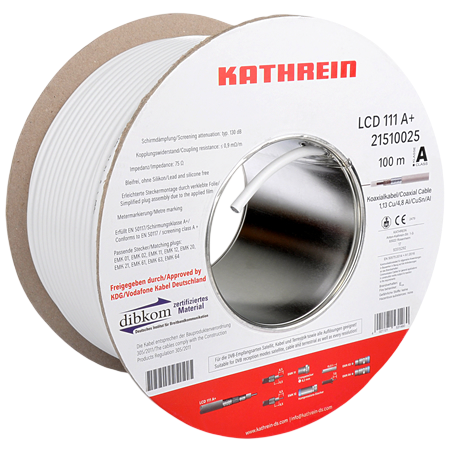
Coaxial Cables in Professional Installations: Technical Analysis, Performance & High-Specification Selection.
Coaxial cables are not simply installation materials. They are the core transmission medium that determines the quality, stability, and long-term reliability of any TV or satellite signal system.
In small residential projects, performance differences may not be immediately visible.
In professional installations, however, cable selection directly affects:
- Signal attenuation
- Resistance to LTE / 5G interference
- LNB power stability
- Long-term operational reliability
For a basic overview of structure and cable types, see our Coaxial Cables. In this article, we focus exclusively on real-world professional applications.
Technical Parameters That Define Coaxial Cable Performance
1. Attenuation (dB/100m)
Attenuation increases as frequency rises.
Indicative reference points:
- 800 MHz (terrestrial digital TV)
- 2150 MHz (satellite IF)
The difference between a standard cable and a high-specification cable becomes critical in long cable runs or branched distribution systems.
In hotel or multi-dwelling backbone systems, a 5–8 dB difference can mean the loss of an entire multiplex.
2. Shielding (Class A / A+ / A++)
Shielding is not only about blocking external interference. It also impacts:
- Noise return within the network
- MER stability
- Prevention of LTE leakage
In high-density urban environments, Class A+ or A++ coaxial cables are effectively mandatory for stable operation.
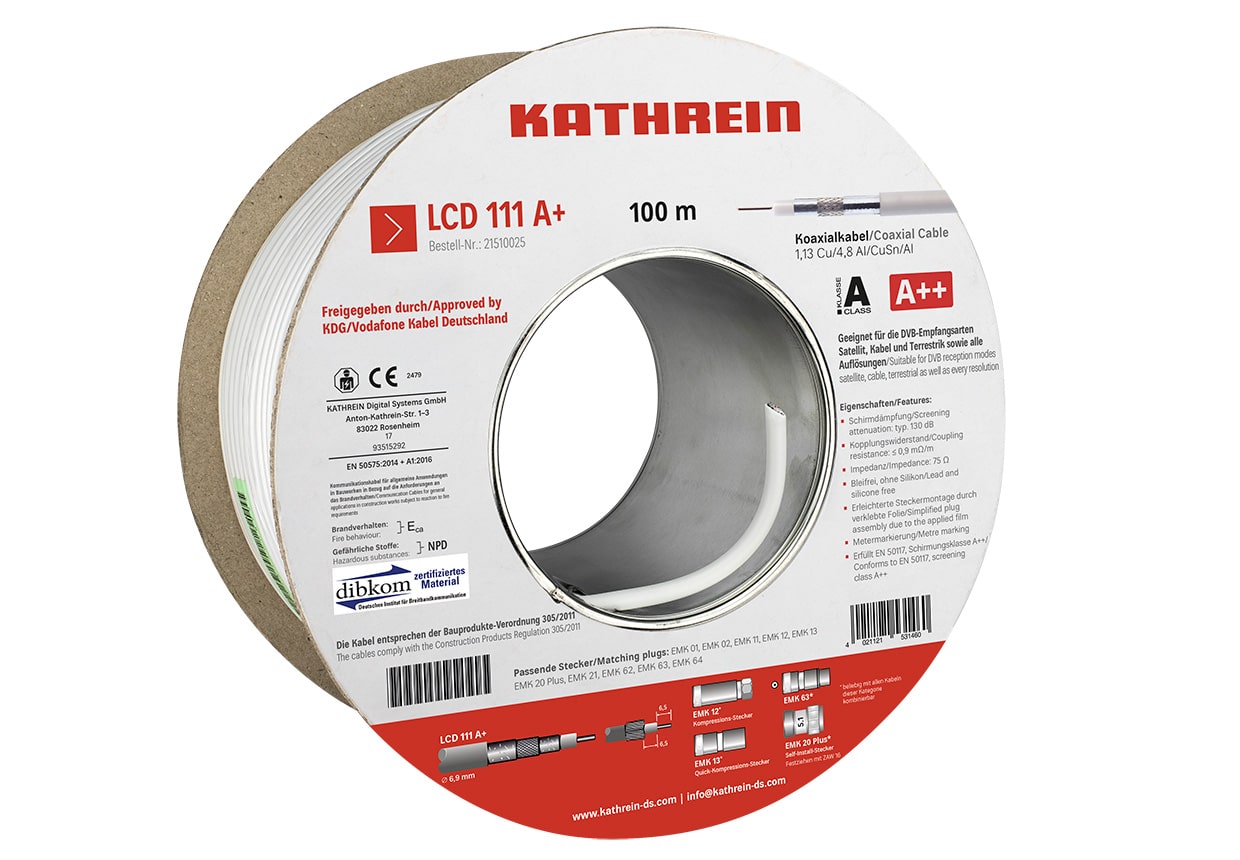
3. Conductor: Solid Copper vs CCS
For professional projects, solid copper conductors are strongly preferred:
- Lower DC resistance
- Stable power passing
- Reduced thermal stress
- Extended service life
In satellite systems, conductor quality directly affects reliable LNB power delivery.
Backbone Design in Multi-Dwelling Buildings & Hotels
In centralized distribution systems, best practice includes:
- Low-attenuation main backbone line
- High shielding classification
- Stable behavior over long distances
- UV-resistant PE jacket for outdoor routing
Using low-quality cable in the backbone often results in:
- Uneven signal distribution
- High-frequency instability
- Service callbacks
High-Specification Coaxial Cable Examples
In professional RF projects, manufacturers such as Kathrein comply with strict European standards for low attenuation and high shielding performance.
🔹 LCD 130 A++ (RG6)
The Kathrein LCD 130 A++ is designed for low attenuation in demanding applications.
Suitable for:
- Backbone lines
- Long-distance runs
- High frequencies up to 3 GHz
🔹 LCD 115 A++ (RG6)
The Kathrein LCD 115 A++ offers an excellent balance between flexibility and performance.
Ideal for:
- Internal building distribution
- Professional installations
- Projects requiring high shielding
🔹 LCM 17 A+ (RG11)
The Kathrein LCM 17 A+ is engineered for enhanced mechanical durability and signal stability.
Recommended for:
- Outdoor routing
- Harsh environments
- Long-term professional projects
RG6 vs RG11: Technical Comparison
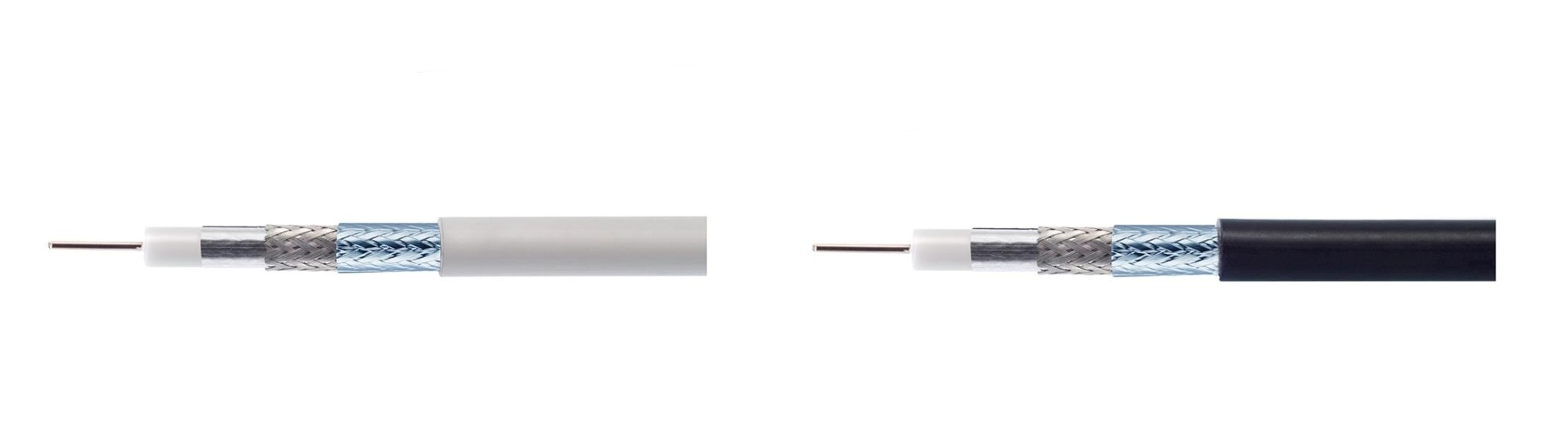
RG6 and RG11 coaxial cables differ in attenuation, diameter, and intended application.
RG6 is typically used for short to medium distribution runs, while RG11 provides lower losses and is preferred for long distances and backbone lines.
Below is a comparative technical table outlining key characteristics and typical attenuation values:
| Technical Characteristic | RG6 | RG11 |
|---|---|---|
| Nominal Impedance | 75 Ohm | 75 Ohm |
| Conductor Diameter | ~1.02 mm | ~1.63 mm |
| Overall Diameter | ~6.8–7 mm | ~10 mm |
| Attenuation @ 800 MHz (per 100m) | ~15–18 dB | ~12–14 dB |
| Attenuation @ 2150 MHz (per 100m) | ~28–32 dB | ~20–22 dB |
| DC Resistance | Higher | Lower |
| Backbone Suitability | Limited | Ideal |
| Max Recommended Distance (no amplification) | 30–40 m | 60–100 m |
| Flexibility | High | Moderate / Lower |
| Typical Application | Apartment distribution | Main backbone line |
Practical Design Example
In a 6-floor building with a 60 m vertical backbone:
- Use low-attenuation cable for the main riser
- Carefully calculate splitter losses
- Distribute to apartments using suitable cable type
- Measure and verify MER and BER
Proper engineering design dramatically reduces future service interventions.
Why High-Quality Coaxial Cable Reduces Callbacks
In professional projects, cost is not limited to materials. It also includes:
- Time
- Reputation
- System reliability
Using certified, high-specification coaxial cables:
- Maintains signal stability
- Prevents interference issues
- Minimizes technical interventions
Conclusion
Coaxial cables form the backbone of every RF installation.
Selection should never be based solely on price, but on:
- Real attenuation values
- Shielding classification
- Conductor quality
- Compliance with European standards
When the backbone is properly designed, the entire installation remains stable for years.
Discover Professional RF Solutions from Kathrein
Kathrein is a reference name in telecommunications technology, delivering reliable solutions for communication networks worldwide.
We support technicians, companies, and professional partners by providing solutions that combine innovation, quality, and reliability.
With Kathrein, technology becomes a tool for operational stability and long-term network growth.
Contact us today to learn how we can help you fully leverage advanced RF technology and develop your network with professional Kathrein solutions.
